Ian Moyse Technology Influencer & Sales Leader
Did you know that by age 10, approximately 40% of children have a mobile phone. By age 14, that number climbs to 91%. The same Census shows that nearly one in five tweens, between ages nine and 12, say they use social media every day, despite the regulations for most apps that require children to be at least 13 years old to use them. Nearly 40% of children 8 to 12 years old and 95% of children 13 to 17 years old use social media apps.
So those are some blatant and frightening stats. But what about the real-world realities now and for the future!?
We already have governments putting in place or debating regional age limits on social media and the banning of it for under 16’s, at least in school if not fully. If it were not a harm to them, why would this even be considered!? And out of the public eye the big leaders in the technology sector that bought us this tech, in fact keep their own kids away from smart devices and social media! Bill Gates, founder of Microsoft, stated he did not let his kids have smartphones until they passed age 14 and Steve Jobs, Apple Founder, quoted in interview “We don’t allow the iPad in the home. We think it’s too dangerous for them” he said when asked whether his kids loved the iPad he had bought to market.
The devices with touch screens have educated us all to automatically swipe and expect screens to be touch controlled and to behave in the same way. How easily and quickly we are programmed! That’s us at adults, indoctrinated to the need, to the behaviour and semi-addiction of these devices.
‘People on average pick up their smartphones 100-150 times a day’ (Source : Slicktext)
At what age though is it a smart decision to allow access to a smart device let alone to let them have their own?
Seeing babies in their pram and at dinners in resteraunts with a smartphone stuck in front of them, is seemingly becoming a norm. For the kids in reverse their norm is being programmed (by us as adults) to a world where they have a screen as a potential babysitter, an entertainer and a pacifier.
We are creating a norm where the screen access is expected and yet there is already evidence to show that the screen time and what can be accessed via the device is not good for a child’s mental health, especially when you consider that the child protection tools are less than adequate for the threats that the device provides access to.
Interestingly UK adults are cited as having an average 4.5 hrs online daily total (mostly on phones (Source : Ofcom), however Teens average 7 hours 22 mins a day (Source : Exploding Topics) So we are seeing new generations with greater use, bordering on addiction to the devices in hand.
At home we protect kids physically as they grow with cupboard locks, stairgates, corner protectors, plug barriers; we take responsibility to protect them from physical dangers until they mature and are able to protect themselves and make sensible resiliency decisions
Yet with smart screen devices that have a mental impact (much unknown or only suspected at this time), we do far less to protect their mental health in comparison with their physical. Many will claim they do not give unfettered access and limit time and monitor access, however how do we know how much is healthy and are the protection tools that limit access good enough?
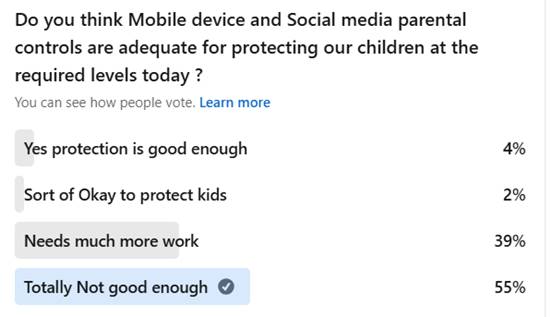
In a recent survey I ran online, 94% said they found mobile and social media controls need more work to be adequate for protecting our kids.
One simple example of this being with Apple devices, with the screentime function; if your child requests access to an application or game, the only options given are for 15 mins, an hour or all day. Give them an hour or all day and want to rescind it, and it’s not a simple click to achieve if at all. A very simple example but why is this not a time dial, if you want to allow them 25 mins or 45 for example why can you not select this and then have a simple view list of apps granted and time given and time left where you can remove or alter this quickly and simply?

The tools provided need far more function, flexibility ease and protection. We have giant multi-billion $ organisations who could without a blink improve the protection for kids massively very quickly. The big question with all their smart design and resources why have they not or show no signs of doing so. Why because they know we, the consumer is their product, are their revenue and future revenue! The more and earlier they hook a child to their product and usage the more is in it for them.
Apple has just announced a major screentime overhaul coming in Sept 2026 (long overdue) with some great new features (updated time allowances, daily schedules and stricter approval tools), however it will require all devices to be upgraded to IOS27 and only supported by Iphone 11 and above.
However, all this is purely at the device level. Go further and give your kids access to apps such as Youtube, Snapchat, Tiktok, Whatsapp as the big names of risk or a volume of other games or apps that you may approve for them not knowing what they are really seeing or experiencing and we have a layered gigantic problem.
We have apps which themselves have inadequate protection and child limiting options within them, for the same reasons; they want kids on them digesting content, generating a user base that they can monetarise for their own financial gain.
Do not get me wrong or as a technology fun blocker. I have always loved technology, its possibilities, its innovation, gaming and the ability to do things on the move anywhere when you want. The gains of a smart phone from calling an Uber, through ordering something on Amazon, having mobile payments, checking a flight, turning on remote heating and navigation to a location are amazing innovations which we now all take for granted. However, there have to be checks and balances and consideration of the impact on individuals negatively as well as positively.

Recent observations I have had, and I am sure you will recognise all or some of these;
- Sitting in a resteraunt on holiday with 2 children sat at a table opposite, of ages around 2-4ys each with a tablet each propped on the table and headphones on whilst they eat their buffet dinner with their parents. No human interaction, no awareness of the social world going on around them!
- On a recent flight a child of around 6, who for the totality of the flight was glued to a screen from the moment they were sat down to the moment of landing, even continuing when given food and to add insult to injury at times having the sound on (no headphones) when playing a game so all around can hear (when did this become a thing!?)
- And possibly worst, at a UK resteraunt seeing 6 kids of estimated ages 6-8 at a large separate table out with a group of parents where all of the kids spent the whole meal head down on screens each not interacting with adults or the other kids.
Are we at a time when educating for a lack of social interaction and skills is the baseline? Are we going to see people sat at dinner tables messaging or emailing each other instead of speaking or not going out at all in fact?
Are we the unusual parents as it feels who limited kids having smart devices until age 11, and then had to succumb to the peer pressure that their friends had Whatsapp and they were missing out on invites and meet ups due to not being online?
The debate will continue and as I was writing this, we saw the big mainstream news coverage and debate that ensued of the UK banning social media for under 16’s as many other countries have already enacted. Will this actually happen and how will it be enforced is yet to become clear!

What is clear is that this is a very emotive subject and one where there is no easy answer, but an area where it is critical that we intervene more than we have and start to understand quickly the implications and dangers that we have unleashed on young minds.
Even with devices and screentime, it is an effort to restrict both technically and emotionally, but is it not worth that effort and sometimes battles for the longer term gain of mental health and sociability in the upcoming youth of today.


